October Port Rail Index Shows Regulatory Crackdowns and Declining Imports Threaten Drayage Market Stability
October 15th, 2025 1:36 PM
By: Newsworthy Staff
The October ITS Logistics Port/Rail Ramp Index reveals that declining import volumes combined with new CDL enforcement regulations are creating significant challenges for the drayage market, potentially leading to carrier bankruptcies and supply chain disruptions.
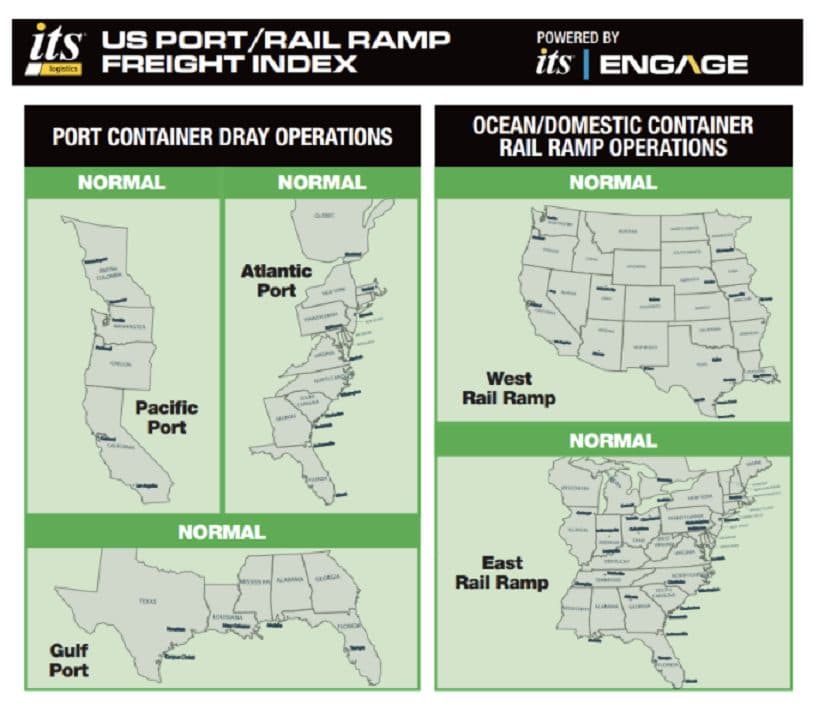
The October ITS Logistics US Port/Rail Ramp Freight Index indicates that while port and rail ramp operations continue to function smoothly, declining import volumes and new regulatory pressures are creating significant challenges for the drayage market. Import volumes have continued their downward trend, with September projections at 2.12 million TEUs representing a 6.8% year-over-year decrease from the previous year. This decline in container demand has prompted ocean carriers to strictly enforce accessorial fee schedules to maintain profitability during what should be peak shipping season.
Paul Brashier, Vice President of Global Supply Chain for ITS Logistics, described the situation as having storm clouds on the horizon that could negatively impact trucking and, by extension, terminal and port operations upstream. The most significant development involves new regulatory enforcement surrounding commercial driver's licenses. Following a nationwide audit of CDL licenses, the Federal Motor Carrier Safety Administration issued an emergency interim ruling on September 26 restricting eligibility for non-domiciled CDLs. Several states have since implemented enforcement efforts to verify CDL compliance and English language proficiency at weigh stations, ports of entry, and along major transportation routes.
Industry experts warn that non-domiciled CDL holders account for a substantial portion of the lower-cost capacity market, and the regulatory crackdowns will likely result in increased bankruptcies across small and mid-size carriers. The drayage market has already seen multiple major providers close their doors throughout 2025, and stricter enforcement of non-domiciled CDLs and ELP requirements is expected to exacerbate financial challenges. Brashier explained that in the near term, these new regulations will remove capacity from the ecosystem and cause market disruption, while in the long term, they could drive many carriers out of business as they struggle to withstand both evolving regulatory pressures and the ongoing freight recession that has pushed rates down to or below operating levels.
The National Retail Federation anticipates that monthly import volumes will continue to drop for the remainder of the year, citing tariffs and frontloading activity in the first half of 2025. In response to these market conditions, ITS Logistics recommends shippers review their supply chains for any inefficiencies that could be exposed and penalized under the renewed focus on accessorial fee enforcement. Shippers should confirm that accessorial dispute processes and documentation requirements are clearly defined in their standard operating procedures. For supply chains utilizing rail for ocean container movement, understanding items like chassis pool flip policies and which parties to engage with to resolve issues within free time becomes increasingly important.
The compounding factors of declining import volumes and regulatory pressures are placing a downward squeeze on an already soft drayage market, creating potential problems for shippers in both the short and long term. As carriers face increasing financial pressure from both market conditions and regulatory changes, vetting service provider health will become critical for shippers beginning late 2025 and early 2026 RFP activity. The ITS Logistics US Port/Rail Ramp Freight Index forecasts port container and dray operations for the Pacific, Atlantic, and Gulf regions, providing critical insights into these developing market conditions.
Source Statement
This news article relied primarily on a press release disributed by citybiz. You can read the source press release here,