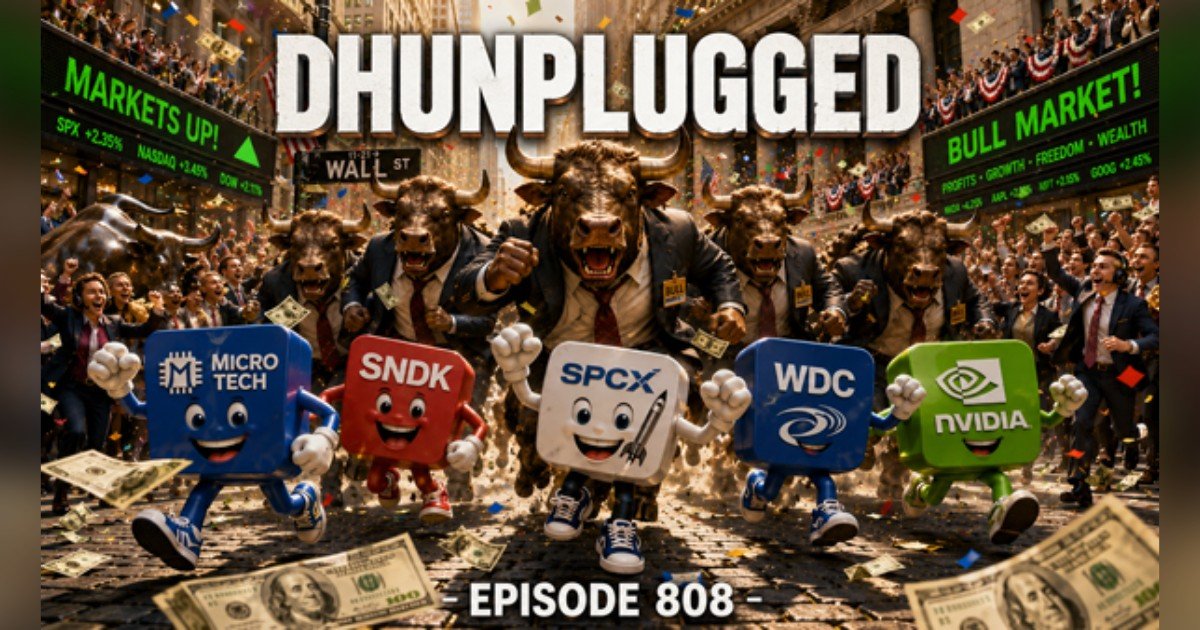
Bulls, Bubbles and a 'Ram Job': Hosts Dissect Memory Price-Fixing Claims
On DHUnplugged #808, Andrew Horowitz and John C. Dvorak unpack a first-half bull run led by AI memory names, a DRAM antitrust class action against Samsung, SK Hynix and Micron, Japan's yen intervention, SpaceX bond losses, and the July 4 launch of Trump Accounts.





Delray Beach, FL (Newsworthy.ai) Friday Jul 3, 2026 @ 9:00 AM EDT
DH Unplugged — DHUnplugged #808: Bulls in a Bubble Shop
Photo: Horowitz and Dvorak
“It's a forced financial literacy experiment wrapped in a political brand name with a socialist starter check to teach capitalism.”
Episode 808 of DHUnplugged, titled Bulls in a Bubble Shop, hosted by John C. Dvorak and Andrew Horowitz, published June 30, 2026, closes out the first half of 2026 with the S&P 500 up roughly 7.5%, the Dow above 52,000, and AI hardware names running like the bulls at San Fermin. With markets shuttered Friday for the July 4 holiday, the BLS jobs report pulled forward to Thursday, and the country's 250th anniversary looming, the hosts tally winners, losers, and warning signs flashing under the surface of the rally.
The conversation ranges widely across the quarter's dominant storylines. Key threads include:
DH Unplugged — DHUnplugged #808: Bulls in a Bubble Shop
Photo: Horowitz and Dvorak
“It's a forced financial literacy experiment wrapped in a political brand name with a socialist starter check to teach capitalism.”
- The alleged DRAM 'ram job' and a new U.S. antitrust class action against Samsung, SK Hynix and Micron
- The July 4 launch of Trump Accounts, the $1,000 Treasury-funded seed for newborns, and host Andrew Horowitz's Kevin Hassett critique
- SpaceX's newly issued investment-grade bonds already underwater, and the stock joining the Nasdaq 100
- Japan's yen at 162 to the dollar, hints of Bank of Japan 'yentervention,' and the widowmaker trade
- PCE inflation climbing to 4.1% and the Bank for International Settlements flagging AI-boom financial-stability risks
Horowitz reserves particular scorn for what he calls a contradiction at the heart of the new Trump Accounts program, which he says was pitched on live television as a lesson in capitalism, ownership and compounding.
It's a forced financial literacy experiment wrapped in a political brand name with a socialist starter check to teach capitalism.
Dvorak, meanwhile, needles the AI infrastructure narrative, arguing compute is heading back to the desktop via Nvidia Blackwell-powered mini machines, which could leave server farms underutilized and memory prices vulnerable to collapse.
The deeper dive centers on memory. SanDisk finished the half up 780%, Micron up 300%, Western Digital up 240%, Seagate up 226%, while South Korea's KOSPI surged 125% behind Samsung and SK Hynix. Yet the hosts revisit the 2005 DRAM price-fixing case in which Hynix paid $180 million, Samsung $300 million, and Infineon $160 million, noting the plaintiffs now allege the same three companies control 90% of DRAM and coordinated supply cuts as conventional DRAM prices jumped roughly 700% over four years. They also cover Chevron's 20-year Project Kilby data-center power deal with Microsoft, Comcast splitting off NBCUniversal and Sky, the Interior Department slashing federal drilling bonds 95% to $25,000, Wendy's brief meme-stock spike after CFO Steve Cyrilus arrived from Potbelly, and gold slipping below $4,000 as Bitcoin sinks to $58,600. Horowitz also previews an upcoming Peter Schiff interview on The Disciplined Investor.
About DHUnplugged
DHUnplugged is a weekly investing and markets podcast hosted by columnist John C. Dvorak and money manager Andrew Horowitz. The show blends Fed policy, earnings, commodities, tech and offbeat cultural observations with a skeptical, humorous, unrehearsed tone. It is available at dhunplugged.com and via Apple Podcasts, Spotify, Amazon Music and RSS. Episode 808 is available now wherever podcasts are heard.
Frequently Asked Questions
- What is the 'ram job' the hosts keep referencing?
- It's Horowitz's shorthand for what he views as coordinated price hikes in the memory market. A new U.S. antitrust class action alleges Samsung, SK Hynix and Micron, which together control roughly 90% of DRAM, shifted capacity toward high-bandwidth AI memory while restricting conventional DRAM supply, allegedly driving prices up around 700% over four years.
- Why does Andrew Horowitz object to the new Trump Accounts?
- Horowitz argues the program, which seeds a $1,000 Treasury-funded brokerage account for U.S. children born between January 1, 2025 and December 31, 2028, was pitched on television as a lesson in capitalism while actually being taxpayer-funded. He calls it 'a forced financial literacy experiment wrapped in a political brand name with a socialist starter check to teach capitalism.'
- Why is Dvorak skeptical of the AI server-farm buildout?
- Dvorak argues compute is heading back to the desktop through Nvidia Blackwell-powered mini machines resembling Raspberry Pis. If AI runs locally, he warns, the enormous server farms being constructed could end up underutilized, potentially collapsing memory prices and leaving significant excess capacity searching for a new purpose beyond speculative uses like Bitcoin mining.
- How did the first half of 2026 shake out for major indexes and memory stocks?
- The S&P 500 finished up about 7.5% and the Dow closed above 52,000 for the first time. Memory names led the charge: SanDisk rose 780%, Micron 300%, Western Digital 240%, and Seagate 226%. South Korea's KOSPI jumped 125%, Samsung gained 169%, SK Hynix 303%, and Japan's Nikkei posted its biggest quarter ever, up 38%.
- What is 'yentervention' and why does it matter?
- It refers to potential Bank of Japan intervention to defend the yen, which hit 162 per dollar, levels not seen since 1986. Despite Japan spending roughly ¥73 billion in buying operations and foreign reserves falling 5.6% in May, U.S. rates remain high while the BOJ moves slowly, sustaining the carry trade that traders call the 'widowmaker.'
- How did SpaceX's new bond issue perform for investors?
- SpaceX raised $25 billion in investment-grade bonds after receiving $85 billion in orders. The 10-year tranche priced at about 1.4 percentage points over Treasuries, or roughly 5%, but yields quickly moved to around 6%, with longer-dated 2046 and 2056 bonds hit hardest. Horowitz notes the stock has climbed to $173 even as bondholders take losses.
Media Contact
Other Recent News for DHUnplugged Podcast
- Judy Shelton, Gold Standard Chatter and Cracks in Credit: Inside DH Unplugged 821
- Bessent's 'Counterfactual' Defense Draws Fire on DH Unplugged
- Bessent Declares 'I Am the House' as CPI, Oil Shock and Bond Yields Rattle Markets
- Oil Spikes, Bond Jitters and a Target Halloween Backlash Rattle September Markets
- Bessent's 'Big Bond Blunder' and 5 Dumb Finance Moves Rattling Markets