Oyster Founder Tony Jamous: Fear-Based Leadership Is Quietly Sinking Companies
On the You Should Know podcast, Oyster founder and Executive Chairman Tony Jamous joins hosts William Tincup and Ryan Leary to unpack why fear drives outdated leadership, how remote work exposes control problems, and what he learned building two unicorns.





Arlington, TX (Newsworthy.ai) Friday Aug 21, 2026 @ 6:00 AM CDT

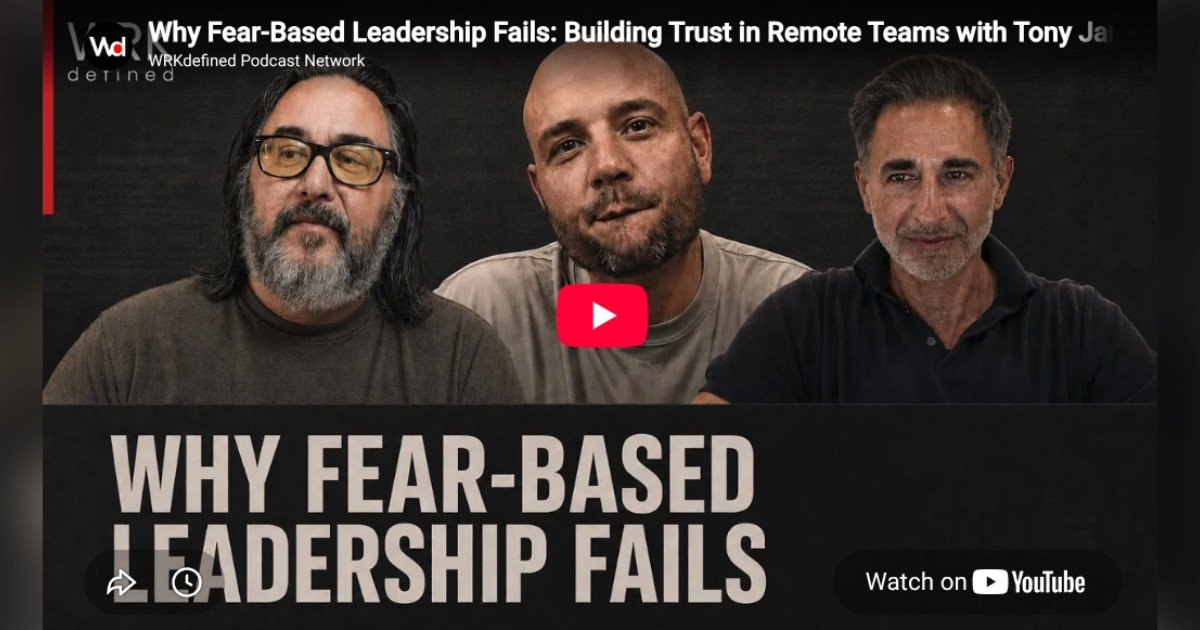
You Should Know — Why Fear-Based Leadership Fails: Building Trust in Remote Teams with Tony Jamous
Photo: WRKdefined
“At the core of many of these outdated leadership models is actual fear from the leader. This fear is driving people, leaders, to behave in ways that is reactive to themselves and others. Instead of trusting people, wanting to control people.”
The August 18, 2026 episode of You Should Know, titled Why Fear-Based Leadership Fails: Building Trust in Remote Teams with Tony Jamous, hosted by William Tincup and Ryan Leary, returns Oyster founder and Executive Chairman Tony Jamous to the mic for a candid conversation about the leadership models quietly damaging modern companies. Recorded with Jamous from Cyprus, the episode argues that surveillance, reactivity, and command-and-control instincts are not strategy; they are fear in disguise, and they are increasingly incompatible with a distributed, global workforce.
The discussion moves quickly from theory to practice. Listeners can expect specific threads including:
You Should Know — Why Fear-Based Leadership Fails: Building Trust in Remote Teams with Tony Jamous
Photo: WRKdefined
“At the core of many of these outdated leadership models is actual fear from the leader. This fear is driving people, leaders, to behave in ways that is reactive to themselves and others. Instead of trusting people, wanting to control people.”
- Why the pendulum between progressive and traditional leadership has swung back toward control as interest rates rose and demand slowed.
- How Oyster, a benefit corporation operating across 80+ countries, uses remote work as a forcing function for trust.
- Jamous's three-part method for shifting from control to trust: defaulting to best intent, practicing non-reactivity, and releasing the illusion of control.
- The launch of Oyster's Global Payroll product and the company's Silver Lake-led funding round closed in Q3 of the prior year.
Jamous is direct about the psychology driving executives into old habits. "One of the most damaging stories leaders tell themselves is that if they missed the quarter or the year, they're going to die," he says, framing Wall Street pressure as a wiring problem rather than a business reality.
You have 100% control by controlling your behavior at the top as a leader of the organization. You have to default to assuming best intent.
The conversation goes deeper than tactics. Jamous, who was born in Lebanon and previously took an API software company public before it was acquired, describes the personal shift between his first and second unicorn as "ego reduction." He credits leadership coach Pascal with a pivotal observation after the first exit: that the same outcome could have been reached by taxing himself and those around him less. Tincup and Leary connect that idea to hiring for ethics (Jamous argues you build ethical environments, not screen for ethical people), the story of an Oyster teammate in the Philippines who broke down when she realized she was trusted, and the concept of a "clean company" vibrating at high trust. They also revisit Oyster's mission to reverse brain drain and reduce wealth inequality by democratizing access to global job opportunities.
About You Should Know
You Should Know is a podcast on the WRKdefined Podcast Network, based in Arlington, Texas, reaching more than 3.9 million verified listeners each month. Co-hosted by Ryan Leary and William Tincup, the show tackles pivotal leadership challenges, workforce dynamics, career mobility, and the impact of technology on hiring. This episode is available now wherever podcasts are heard, and at wrkdefined.com.
Frequently Asked Questions
- Who is Tony Jamous and what is Oyster?
- Tony Jamous is the founder and Executive Chairman of Oyster, his second unicorn company. Born in Lebanon and now based in Cyprus, he previously founded an API software company in 2010 that connected banks and other businesses to global telecom networks, took it public, and saw it acquired. Oyster is a fully remote benefit corporation operating across 80+ countries with a mission to reverse brain drain and reduce wealth inequality by democratizing access to global job opportunities.
- What is Jamous's three-part method for shifting from control to trust?
- Jamous prescribes three practices leaders must learn. First, default to assuming best intent and let go of intrusive thoughts that employees aren't working hard enough. Second, practice non-reactivity so team members feel safe telling the truth about missed targets. Third, release the illusion of control, recognizing that leaders actually control a much smaller subset of things than they think, and that trying to control everything blocks creativity and opportunity.
- Why does Jamous argue you can't hire for ethics?
- Jamous contends that ethical behavior is a combination of who someone is plus the environment they operate in. Rather than screening candidates for ethics beyond obvious disqualifiers, leaders should build environments where compliance and service are non-negotiable norms. When there is no top-down pressure to race past regulations to hit financial targets, people behave ethically regardless of their past experiences.
- How does Oyster define culture in a fully distributed company?
- Jamous says company culture is stronger than local country culture in a global remote business, and that leaders must make that intentional so people feel included wherever they log in from. Culture becomes "how you get stuff done here"—whether teams trust each other, address hard topics, give uncomfortable feedback, follow ethical standards, and use shared practices like Slack, pre-reads, and async meetings.
- What did leadership coach Pascal tell Jamous that changed his approach?
- After Jamous sold his first company for a multi-billion-dollar exit, his longtime coach Pascal told him he could have achieved the same success, if not better, by taxing himself less and taxing those around him less. Jamous calls that statement the pivot point between his two companies and the beginning of what he now describes as "ego reduction" and a shift from personal success to being at service to the world.
- What is happening at Oyster commercially right now?
- Oyster is focused on delivering high-touch service at scale using AI, and recently launched a Global Payroll product that Jamous says is selling well beyond expectations by acting as middleware for companies with entities in multiple countries. The company also raised a roughly $300 million round led by Silver Lake in Q3 of the prior year, which Jamous notes made them the only player in their category to raise since interest rates rose.
Media Contact

Other Recent News for You Should Know Podcast
- HiringBranch Study: Scoring Soft Skills Separately Weakens Frontline Hiring Predictions
- ServiceNow's John Phillips: Stop Measuring AI Adoption, Measure Work Outcomes
- Paper I-9s, AI Bias and $27K Fines: Where HR Compliance Breaks in 2026
- Burning Glass Study of 12M Workers Reveals Which Employers Actually Build Careers
- isolved and Remote Partner to Bring Global Hiring Infrastructure to SMBs