Tidio Research Finds AI Influences Half of Purchase Decisions but Receives Credit for Less Than 1% of Web Traffic
Tidio's new report highlights a significant 'dark AI' attribution gap, showing AI's major influence on purchase decisions despite minimal visibility in web traffic analytics.





Chicago, IL (Newsworthy.ai) Friday Mar 27, 2026 @ 5:00 AM EDT
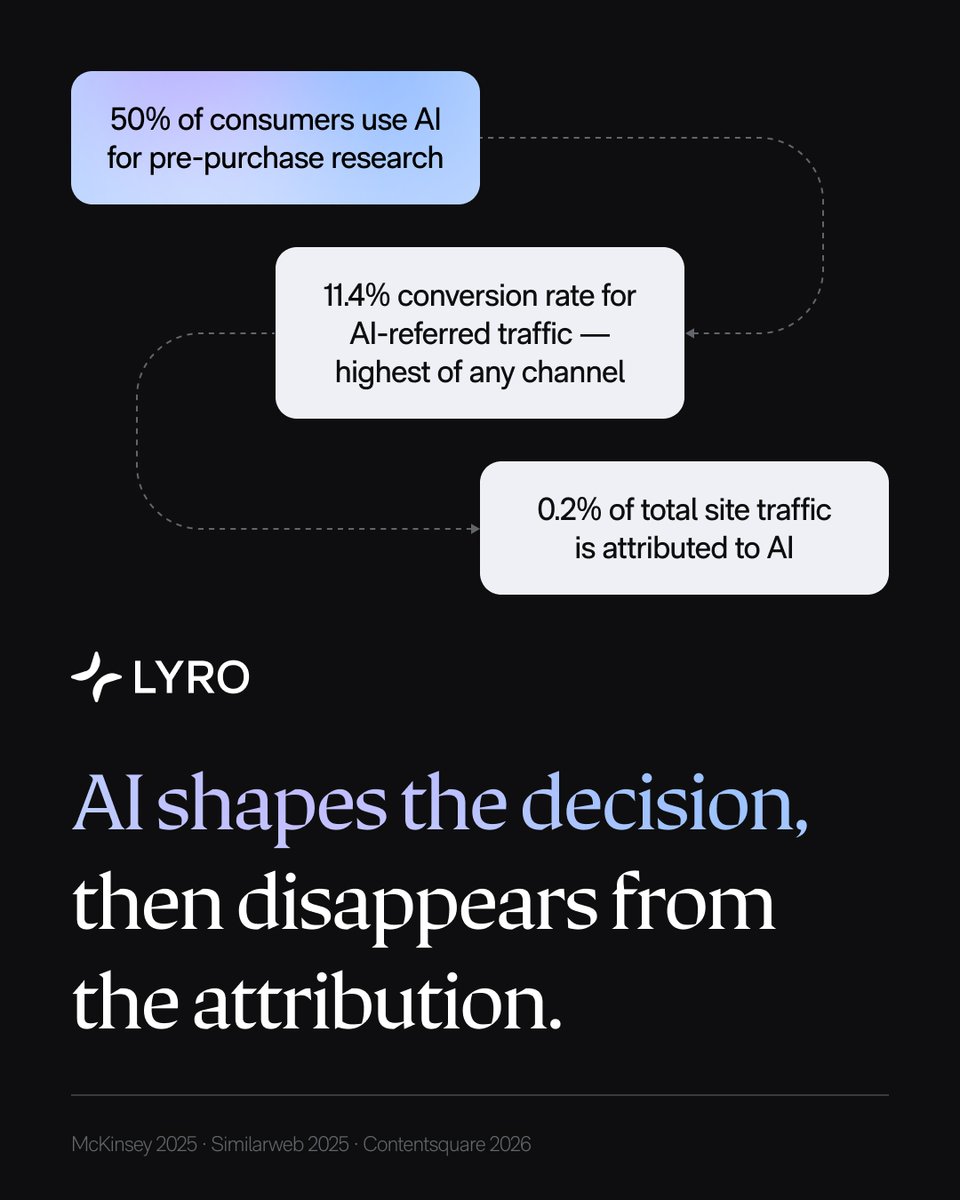
Half of internet users have purchased with AI as a touch point. Their purchasing intent is higher than most channels.
"Brands making budget decisions based on last-click attribution are optimizing for a measurement system that cannot see what is actually driving demand," said Tytus Gołas, Founder and CEO of Tidio.
According to McKinsey, half of consumers now rely on AI as their primary or preferred source for product research. Contentsquare's analysis of actual retail web traffic puts AI-referred sessions at 0.2% of total visits. Both figures are accurate - and the gap between them is the subject of a new research report published today by Tidio.
The report, AI in E-Commerce in 2026: The New Shopping Funnel, draws on more than 60 sources including McKinsey, Contentsquare, Similarweb, Bain, and Tidio's own platform data. Its central finding is that AI is shaping purchase decisions at a scale that standard attribution models are structurally unable to capture.
Half of internet users have purchased with AI as a touch point. Their purchasing intent is higher than most channels.
"Brands making budget decisions based on last-click attribution are optimizing for a measurement system that cannot see what is actually driving demand," said Tytus Gołas, Founder and CEO of Tidio.
The mechanism is straightforward. A consumer asks an AI assistant which product to buy, receives a shortlist of recommendations, and navigates directly to one of those brands via a new browser tab or a branded search. The resulting session registers as direct or organic traffic. The AI that initiated the journey receives no attribution. The report terms this "dark AI" - influence that is commercially real and analytically invisible.
The conversion data from sessions that do get tagged as AI-referred suggests the undercounting is significant. Similarweb's analysis of U.S. retail data finds ChatGPT-referred sessions convert at 11.4% - the highest rate of any measured channel, ahead of direct traffic at 10.2%, paid search at 9.3%, and organic search at 5.3%. A conversion premium of that magnitude implies that tagged AI referrals represent a high-intent fraction of a substantially larger pool of AI-influenced journeys.
The attribution gap continues to widen, indicating a growing challenge for marketers. TollBit's analysis of AI bot behavior across publisher sites finds that click-through rates from AI applications dropped nearly threefold over the course of 2025 - from 0.8% in the second quarter to 0.27% by year-end - as AI platforms consume more content while generating proportionally fewer outbound clicks.
"Brands making budget decisions based on last-click attribution are optimizing for a measurement system that cannot see what is actually driving demand," said Tytus Gołas, Founder and CEO of Tidio. "The inputs that determine AI visibility - feed completeness, structured data, review coverage - live across multiple teams in most organizations, and no one owns them because no one can see the return."
The financial stakes attached to the gap are substantial. McKinsey projects $750 billion in U.S. revenue will flow through AI-powered search by 2028, with brands that fail to prepare risking 20 to 50 percent of their traditional search traffic. Morgan Stanley estimates AI agents will influence between $190 billion and $385 billion in U.S. e-commerce spending by 2030.
The report also documents the protocol infrastructure being built to formalize AI's role in transactions. Google's Universal Commerce Protocol, OpenAI's Agentic Commerce Protocol, and Visa's Trusted Agent Protocol are creating standardized rails for AI agents to complete purchases on behalf of consumers. Consumer readiness is building faster than most projections anticipated: Omnisend's longitudinal research found that reluctance to allow AI to complete transactions dropped from 66% to 32% in five months between February and July 2025.
The full report is available for download at https://www.getlyro.ai/reports/ai-in-ecommerce
For media inquiries, visit https://www.tidio.com/newsroom
About
Tidio is an AI-powered customer service platform that unifies live chat, chatbots, and AI agents in one help desk. Its AI agent, Lyro, resolves customer inquiries automatically and escalates complex cases to human operators. The platform is designed for fast-growing e-commerce businesses that treat customer service as a revenue function. See https://www.tidio.com for more information.
Lyro is Tidio's AI agent for customer service, tailored to e-commerce, SaaS, and service businesses. Lyro resolves an average of 67% of incoming tickets by taking action rather than repeating FAQs, maintains an AI CSAT score approaching 90%, and doubles as an AI shopping assistant capable of increasing average order value through product recommendations and lead collection. See https://www.getlyro.ai for more information.
Media inquiries: https://www.tidio.com/newsroom
Frequently Asked Questions
- How much does AI influence online purchase decisions?
- AI significantly influences online purchase decisions, shaping half of them, yet it accounts for less than 1% of web traffic visibility. This discrepancy, termed 'dark AI,' is due to AI's role in directing consumers to products without receiving attribution in standard analytics.
- What is the conversion rate for sessions referred by AI compared to other traffic sources?
- Available data is sparse and mixed, but report places it between at levels at least as good as for organic traffic from Google. SimilarWeb reports conversion rates of 11.4%, which is higher than direct traffic at 10.2%, paid search at 9.3%, and organic search at 5.3%. This indicates a high-intent nature of AI-referred sessions, despite their minimal visibility in web traffic data.
- Are consumers open to allowing AI agents to do their shopping for them?
- Yes, consumer reluctance to allow AI to complete transactions has decreased significantly from 66% to 32% within five months. This shift suggests growing consumer readiness for AI-completed transactions, as documented by Omnisend's research.
Media Contact

Tidio does not have any other recent news to report at this time.